


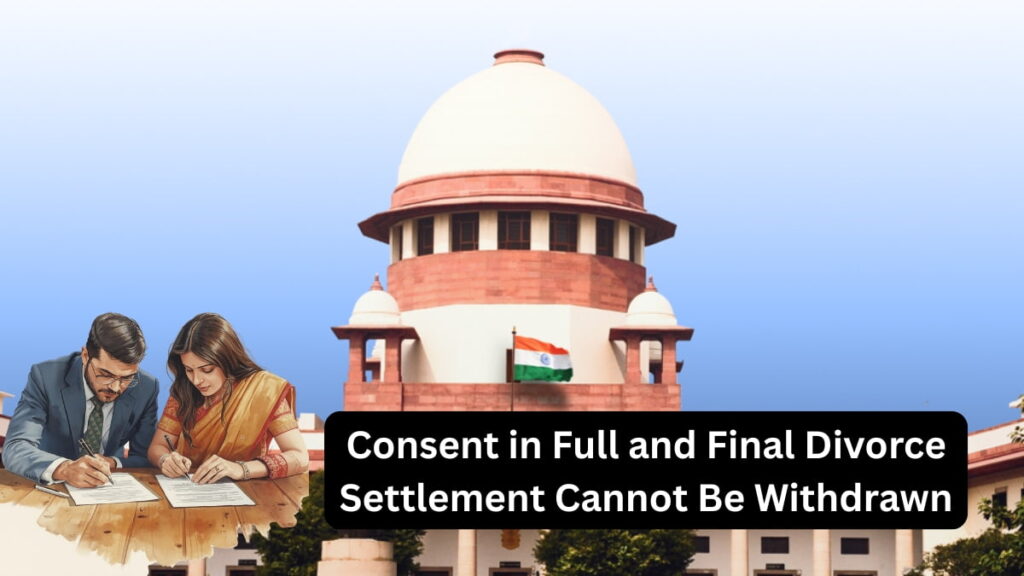
In a landmark ruling, the Supreme Court of India has held that once parties enter into a full and final settlement in a mutual divorce, consent cannot be withdrawn later if the terms have already been acted upon.
The bench of Justice Rajesh Bindal and Justice Vijay Bishnoi also quashed domestic violence proceedings filed by the wife and dissolved the marriage by invoking Article 142 of the Constitution.
Background of the Case
The case arose from a Delhi High Court order dated January 7, 2026, where proceedings in a domestic violence complaint were allowed to continue subject to a deposit of ₹89 lakh by the husband.
The husband challenged this order before the Supreme Court.
The couple had married on February 19, 2000, and had two children who are now adults. Due to personal differences, they started living separately around 2022–23.
Settlement Agreement and Financial Terms
During mediation, both parties entered into a comprehensive settlement agreement on May 16, 2024.
Key terms included:
- Divorce by mutual consent
- Payment of ₹1.5 crore by the husband as full and final settlement
- Transfer of ₹2.52 crore by the wife to the husband for business-related adjustments
- Transfer and relinquishment of properties, shares, and policies
- No future civil or criminal cases between both parties
Following this, the husband paid ₹75 lakh (first instalment), ₹14 lakh for a car, and returned jewellery as agreed. The wife also transferred the agreed amount during the first motion stage.
Wife Withdraws Consent, Files DV Case
After the first motion was allowed in August 2024, the wife later withdrew her consent for the second motion.
She then filed a domestic violence complaint in October 2025, alleging that she had signed the settlement based on oral assurances of additional assets, which were not included in the agreement.
Supreme Court Observations
The Supreme Court framed key issues, including:
- Whether the domestic violence case should continue
- Whether a party can withdraw from a mediation settlement
- Whether the marriage should be dissolved under Article 142
DV Case Termed Abuse of Law
The court found no specific allegations of domestic violence and noted that the complaint was filed much later, making it an afterthought. It ruled that continuing such proceedings would be an abuse of legal process.
Settlement Cannot Be Withdrawn Arbitrarily
The court held that once a settlement is reached and acted upon, it cannot be withdrawn unless there is clear proof of fraud, coercion, or non-fulfilment of terms.
It rejected the wife’s claim of oral assurances, stating that:
- No such terms were part of the written agreement
- No supporting evidence was provided
The court also strongly criticised claims related to hiding assets to avoid tax scrutiny.
Marriage Dissolved Under Article 142
Invoking its special powers under Article 142, the Supreme Court held that the marriage had irretrievably broken down with no chance of reconciliation.
Final Directions by the Court
The Supreme Court:
- Allowed the appeal
- Quashed the domestic violence proceedings
- Dissolved the marriage
- Directed payment of the remaining settlement amount
- Ordered refund of ₹89 lakh with interest
- Barred any future litigation between the parties
- Directed execution of property-related formalities within a fixed timeline
Why This Judgment Matters
This ruling sets an important precedent:
- Ensures finality of divorce settlements
- Prevents misuse of legal provisions after agreement
- Strengthens the validity of mediation outcomes
- Reduces prolonged litigation in matrimonial disputes
Stay Updated With Digi Hind News
For the latest legal news, court judgments, and national updates, visit DigiHindNews.com regularly, bookmark the website for instant alerts, and share this article to stay informed. Stay informed, stay ahead with DigiHindNews.com.
Add Digi Hind News as preferred source on Google for reliable and timely updates